Numbers 16
“He took his stand between the dead and the living, so that the plague was checked” – Numbers 16:48
I remember back when I was in Junior High (now called Middle School), that we would have class officers. Every year, some ambitious kid would run for class president. A thirteen-year-old kid had just a few weapons at their disposal to win over their classmates. You could be enormously popular already, or well-liked, and that may be enough. Or, you could make campaign promises.
Sometimes the campaign promises could be pretty ridiculous. Like four-hour lunches. Or free pizza in the cafeteria. Maybe vending machines outside every class. Thirteen-year-olds are pretty motivated by food. But these were empty promises. The class president didn’t really have much power. It was primarily a symbolic role. It derived all its power from the true authority, the principal. Even if the class president got every kid in the school to walk out with him, all that would result would be some detentions and suspensions. The role had to operate within the authority of the power behind it. And to forget that power would be to your own detriment.
In Numbers 16, we come to the infamous Korah’s rebellion. Korah is the class president that forgot where his authority comes from. The context for this is important. Israel had been saved out of slavery in Egypt by the Lord. They had been promised that He would be their God, and they His people. As they approached the promised land, the people did something that revealed exactly how much they trusted God. God said He would take them in. But they trusted in their own strength and spied out the land. Famously, only two of the spies showed their faith in the Lord. Caleb and Joshua. But the rest feared the people of the land and convinced the population to reject God’s promises and not go into the land.
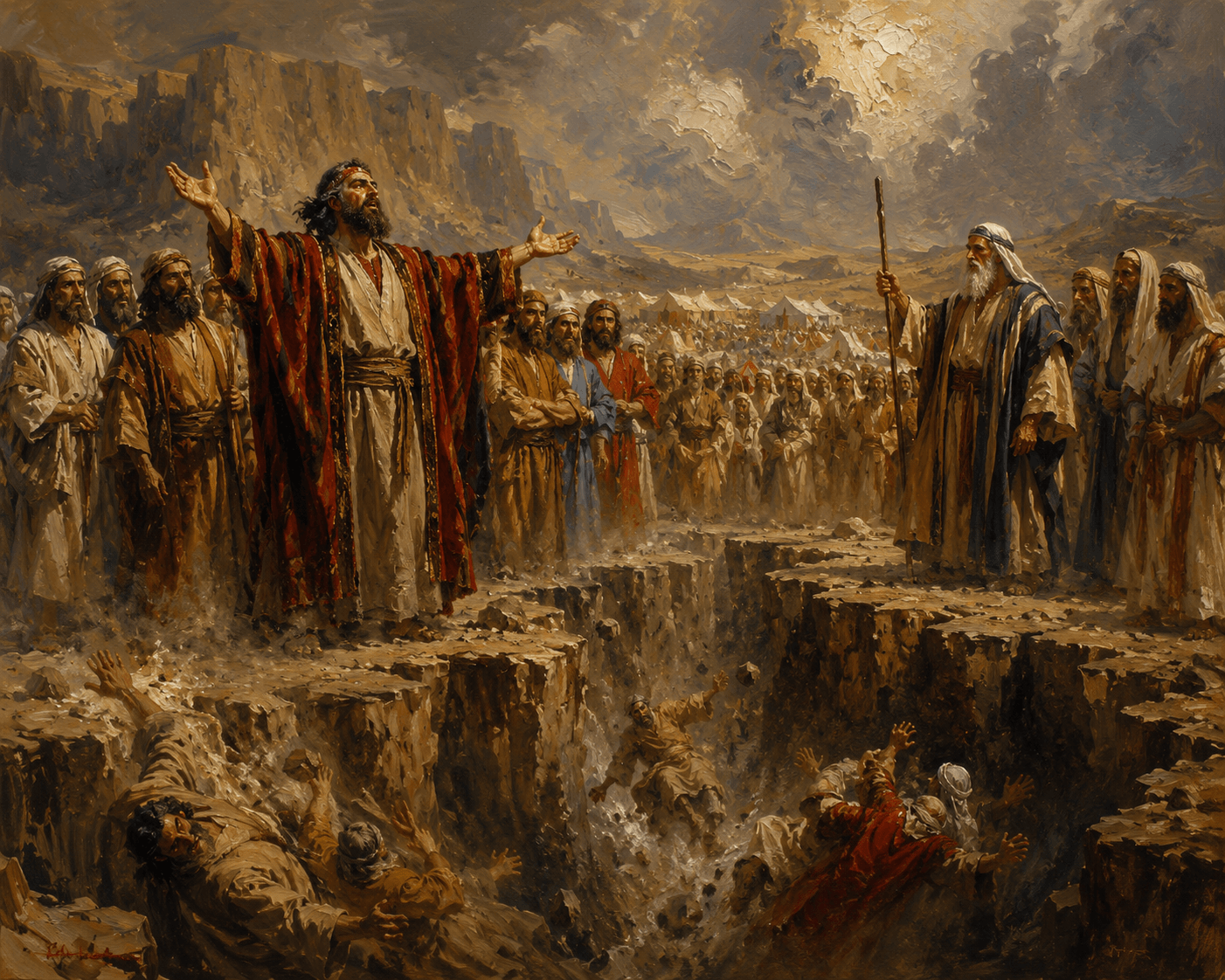
Understandably, the Lord’s anger burned against them. They were then told they would wander the desert for 40 years until all that generation died off. Only their children would go into the land. In Numbers 16, after this pronouncement of judgment, we get Korah’s rebellion. Korah and 250 of his friends decide that Moses and Aaron shouldn’t be the priests and prophets. They think they know better– and they seek to overthrow Moses and Aaron and take over leading the people. Again, God’s anger burns, and he judges Korah and his followers swiftly.
But then we get this interesting epilogue to this rebellion. Even after seeing the judgment from lack of faith in spying out the land, and seeing Korah and his followers swallowed by the earth and struck down by fire, the people still rebel. In verse 41 they “grumbled”. They, incredibly, blame Moses and Aaron for the people that were struck down. Despite all they had seen, they gather together, once again in opposition to Moses and Aaron.
But, this time, something really profound happens. God plans to wipe these people out. A plague begins to spread among the people in verse 47. Moses commands Aaron to offer sacrifice for the people. To make “atonement”.
After they do this, we are given this incredible verse. Verse 48. “He took his stand between the dead and the living, so that the plague was checked”.
Moses in this moment becomes a picture of Christ. Hosea 6:6 says “I desire love, not sacrifice” and Isaiah 1:11 says the Lord ‘has enough of your sacrifices’. Both passages point to the fact that God really desires something more than just ritual. So what does He desire? Love. Through faith. In this chapter, the real plague spreading through the camp is lack of belief. The people didn’t believe God’s promises about the land. They didn’t believe the truth given by Caleb and Joshua that the Lord was good. They didn’t believe that Moses and Aaron were put in place by God and represented God to the people. They didn’t believe God when he smote Korah and his followers. And, they didn’t believe God when their own wickedness brought a plague of death upon them.
Yet even so, Moses stood between the dead and the living. Offering the atonement for sin. What a picture of Christ. Who, despite our rebellion, like Hosea 2:14, “allures us” and “speaks kindly to us”. He seeks us, out of His great love. He then stands between the penalty of our sin, for us the dead, and the living God. He became the atonement for sin, and by taking the penalty of our sin, in place, gives us His righteousness. So that the plague of sin and death is checked. It’s no more.
May we never forget the one who stood between the dead and the living. All praise to Jesus, our Lord, and the author and perfector of our faith.
Amen